-58.jpg)
12 lessons from 12 months in the UK
One year of SpacetoCo, live and growing with UK hosts and hirers 🇬🇧 Twelve months ago, we launched in the UK not knowing exactly how the market .
.svg)
What it is, why it matters, and how to get started.
In short: Space sharing means opening up underused spaces — schools, offices, cafes, community halls, even homes — to the wider community outside their normal hours. Most buildings sit empty for large parts of the day, week or year; space sharing puts that downtime to use instead of wasting it.
Whichever way you look at it, humans are for the most part brilliant at building stuff… the basic human need of shelter is largely covered… check…we have nailed that down 😉 The thing is, we absolutely suck at making the most of these structures. We can build any structure but we often rely too much on the adage, 'build it and they will come'…
There's no better illustration than your local school. Most schools are used effectively from 8am to 4pm, about 40 weeks of the year — around 1,600 hours annually. Factor in evenings, weekends and school holidays, and there's over 3,100 usable hours sitting idle every year: more than a third of the calendar. Playing fields, halls, libraries, classrooms, maker spaces and theatres, funded by the community, used by almost no one outside school hours.
Across the country, thousands of community halls, sporting pavilions and meeting rooms sit dark for hours every day for exactly this reason — and the cost of that idle time is bigger than it looks. SpacetoCo's research on the cost of loneliness found that unused community assets aren't just a maintenance liability, they're a missed opportunity to tackle social isolation directly.
The same logic applies to churches, offices, cafes and homes. Platforms like meetup.com made it easier for people to find each other online, but the missing piece was always where to actually meet. Space sharing closes that gap: it puts a marketplace around all the physical space we already have, rather than building more.
Shared spaces give hirers flexibility (rent by the hour instead of committing to a lease), mobility (move locations as needs change), and lower cost (no landlord tying up cash you don't have to spare). For hosts, it means better use of a space that would otherwise sit empty, plus the connection that comes from bringing new people through the door.
At SpacetoCo, we're an online marketplace and booking platform built for exactly this — connecting councils, schools, community venues and businesses across Australia and New Zealand with the people who need their space.
Civic buildings (local government): town halls, community halls, leisure centre resources, libraries, parks, sporting reserves, function spaces and more.
Non-commercial spaces (schools, churches): ovals, halls, auditoriums, gyms, libraries, classrooms, maker spaces, community gardens and more. (See how St Luke's church in Remuera opened up its spaces.)
Commercial spaces: cafes, boardrooms, office desks, event spaces, commercial kitchens, galleries and more.
Residential spaces: backyards, studios, home offices, tennis courts and more.
Not sure where to start turning a spare room into something more active? SpacetoCo's guide to activating community venues walks through practical, low-effort ways to bring a quiet space back to life, and once it's active, 100 community event ideas is a useful list for filling that new-found availability.
This page covers the basics. For the detail:
Space is essential to us, and it used to be shared far more naturally. In small towns and ancient cities it happened by default. In modern cities of millions, separated by cars, fences and suburbs, we have to work harder at it.
Working from anywhere has also become a permanent fixture for a lot of people, but a home office doesn't always cut it. Some days all you need is a quiet room. Other days you need a recording studio, a small meeting space, a consulting room or a green screen — resources most of us don't have lying around at home. Occasional space sharing fills exactly that gap: source what you need, when you need it, close by.
There's a bigger-picture case too. Concentrating everyone into one CBD tower comes with its own friction, and commercial rent in city centres remains one of the biggest overheads for any business. Spreading work and activity across suburbs through space sharing could mean less commuting, less congestion, and more money staying in local economies instead of covering city-centre rent.
Underneath all of it, we still need to connect with each other, whether that's a meeting, a class, a celebration or a coffee catch-up. Sometimes that just needs a shared space to happen in.
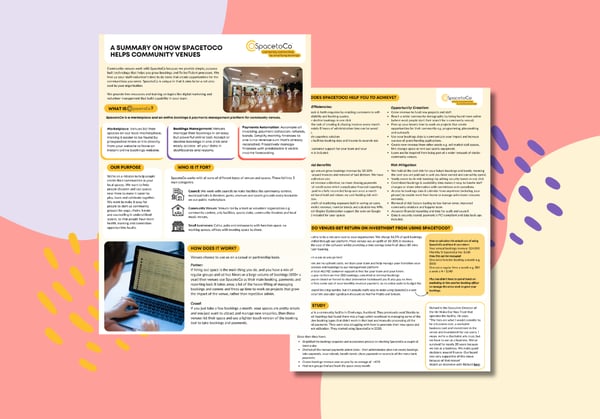
👉 Download the Executive guide
What is space sharing?
Space sharing means opening up underused spaces, such as schools, offices, cafes and homes, to the wider community outside their normal operating hours. Most buildings sit empty for large parts of the day, week or year; space sharing makes that downtime available and usable rather than wasted.
What kinds of spaces can be shared?
Four broad categories: civic spaces like town halls and libraries, non-commercial spaces like schools and churches, commercial spaces like cafes and boardrooms, and residential spaces like backyards and home offices. Almost any space with idle hours can be shared.
Why should a community venue or council consider space sharing?
Space sharing turns unused hours into income and community connection instead of wasted overhead. Platforms like SpacetoCo make it possible to list availability, take bookings and collect payment online, so hosts don't need to manage this manually.
.svg)
Book a personalised demo with a local team member




© 2026 SpacetoCo PTY LTD | All Rights Reserved | hello@spacetoco.com | AU: (08) 6102 1191 | UK: 0330 818 2437 | NZ: (09) 887 4698
©️ 2025 SpacetoCo PTY LTD | All Rights Reserved |
AU: (08) 6102 1191 | NZ: (09) 887 4698