

How to Write a Winning Grant Application for Your Community Venue
Editor's note: At SpacetoCo, we work with community venues that rely on grants to upgrade, grow and stay open. In this guest post, Luke Hegarty, .

Editor's note: At SpacetoCo, we work with community venues that rely on grants to upgrade, grow and stay open. In this guest post, Luke Hegarty, founder of Clarity Insight, shares how to write a grant application that assessors can say yes to. Luke spent more than 14 years designing and managing funding programs in state and federal government, and has led not-for-profit organisations, so he knows what assessors look for.
A winning grant application answers the funder's questions in the funder's order, shows clear evidence of need, and makes it easy for an assessor to see exactly what their money will change. Good writing helps, but most applications succeed or fail on fit and evidence.
Here's how to write a grant application, step by step.
Read the guidelines once to check you're eligible and once to understand how you'll be scored. Most funders publish their assessment criteria. Write them down and use them as the outline for your application. Note how each criterion is weighted, too. That tells you where to spend most of your words. If you're not eligible to apply in your own name, an auspice organisation may be able to apply on your behalf.
Many funders have a grants officer you can contact before you apply. A short call can tell you whether your project fits and what past successful applications had in common. Many applicants skip this, so it can set you apart.
Before you write a word for a funder, be clear on the story you tell your own community: who you serve and the difference your venue makes. A funder is simply a new audience for a story you should already be telling.
Assessors want to know why this project matters now. Show them who uses your venue, how often and what's stopping you from doing more. Booking records, waiting lists and letters from regular hirers are stronger than general statements about community demand.
Say what will be different when the project is finished, and how you'll measure it. "Two more weekly programs for seniors" is stronger than "increased community participation".
Get written quotes for building works and equipment. Include every cost, show any co-contribution you're making (check out this post on how match funding works), and make sure the figures match the rest of your application. Budgets that don't add up are an easy reason to say no.
Letters of support from user groups, local organisations or your council take time to arrive. Ask for them as soon as you decide to apply.
Use short sentences and plain language. Answer each question directly, using the funder's own terms where they fit. Ask someone outside your committee to read it before you submit.
Many funders will give feedback if you ask. It's the fastest way to improve your next application.
The most common mistake I see is writing the application from your own point of view rather than the funder's. Venues explain how much they need a new roof or kitchen, but the funding body is really asking what that will make possible for the community, and how it helps them meet their own goals. When I was assessing grants in government, the strongest applications made that connection in the first paragraph. Lead with the outcome, not the need.
The strongest applications are backed by real numbers. SpacetoCo records every booking, so you can show funders your occupancy, hire income and the range of groups using your space, all exported in minutes. Your booking history also shows exactly who your regular hirers are, which makes it easy to know who to ask for letters of support.
Already on SpacetoCo? Export your booking reports to give funders the usage evidence they ask for.
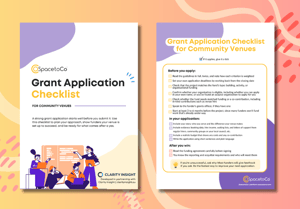
Download our free grant application checklist for community venues.

Luke Hegarty spent more than 14 years in state and federal government designing and managing funding programs, including the NDIS Information, Linkages and Capacity Building (ILC) framework and the $60 million Aboriginal Ability Links Program, a NSW Premier's Award winner. He has also led not-for-profit organisations, so he knows grants from both sides of the table.
Luke founded Clarity Insight to help purpose-driven organisations unlock funding that benefits their communities and helps them thrive.
To find the right funding for your venue or strengthen your next grant application, contact Luke Hegarty, founder of Clarity Insight, for an obligation-free conversation.
Website: clarityinsight.au
Phone: 0417 901 066
Email: luke@clarityinsight.au
Want to see how venues can benefit from grants they never applied for?
Join us for The CoLab on 24 November.
This guide is part of a series on funding for community venues:

Book a personalised demo with a local team member




© 2026 SpacetoCo PTY LTD | All Rights Reserved | hello@spacetoco.com | AU: (08) 6102 1191 | UK: 0330 818 2437 | NZ: (09) 887 4698
©️ 2025 SpacetoCo PTY LTD | All Rights Reserved |
AU: (08) 6102 1191 | NZ: (09) 887 4698