

12 lessons from 12 months in the UK
One year of SpacetoCo, live and growing with UK hosts and hirers 🇬🇧 Twelve months ago, we launched in the UK not knowing exactly how the market .
.svg)
Community halls, arts centres, and sports pavilions do more work than their size suggests. A single hall might run an after-school programme one morning, host a family counselling service that afternoon, and hand its keys to an amateur theatre group by the weekend. Despite that workload, most councils still manage these bookings the way they did a decade ago: paper forms, shared inboxes, and no way for residents to check availability online.
This gap matters because a council booking system for community facilities affects more than back-office efficiency. It affects whether residents can actually find and use the spaces their rates already fund. This article covers why community facility bookings have fallen behind other council services, where the two most common fixes fall short, and what a bookable ecosystem model looks like in practice.
Most councils' digital transformation efforts have prioritised the services easiest to justify first, like payments, permits, and rates. Community facility bookings have stayed manual because they don't sit clearly inside any one department's mandate, so they're rarely first in line for investment.
Between 2021 and 2022, the share of Australian councils with a defined SaaS migration strategy almost tripled, from 13% to 37%, according to the Local Government Digital Transformation Index. That kind of growth shows councils are willing to digitise, but facility bookings have typically sat outside that first wave.
For residents, the effect shows up as a website page that's just a list of venue names and phone numbers, with no way to check what's actually free. For council staff, it shows up as time spent on the phone confirming availability that a booking system could show automatically.
Councils have two common ways of addressing this gap, and each solves a real problem while leaving another one untouched.
Facilities network planning and devolving assets. Many councils map out where they could add capacity, and some hand council-owned halls and venues to community trust operators to reduce costs. This is a genuine way to cut overheads and build grassroots engagement in how local spaces get used. But community operators are rarely given the tools to promote their venue or manage bookings once they take it on. Residents still have no reliable way to check what's actually bookable, and there's no consistent way for the council to measure service quality across these facilities once they're devolved.
Internal council booking software. Implementing a booking system for council-run facilities can create real efficiencies, but it typically only covers venues managed directly by council. Community-led spaces, like parish halls, sports clubs, and volunteer-run centres, are left to continue with manual processes. Even where a booking tool exists, it can still function as a form layered over manual work behind the scenes, with staff checking availability by phone, reconciling invoices by hand, or processing bonds and cancellations one at a time.
Both approaches improve one part of the system without addressing the other. Network planning increases the number of available spaces without giving anyone better tools to book them. Internal booking software improves the process for a subset of venues while leaving community-led operators out entirely.
A bookable ecosystem brings every type of facility, council-run and community-led, onto a single platform where residents can find and book any of them online. It works as two things at once.
A discovery marketplace lets residents search and compare available spaces in one familiar interface, the same way they'd search for anything else online. This solves the basic supply-and-demand problem: people can only book a space if they know it exists and can see when it's free. Bringing multiple venues into one marketplace also creates a network effect, where increased traffic to the marketplace lifts bookings across all listed venues, not just the largest or best-known ones.
A shared booking system gives every facility on the platform, regardless of who operates it, the same booking, payment, and administration tools. This removes repetitive admin work from council staff and volunteer committees alike, so their time goes toward running the facility rather than managing a booking inbox.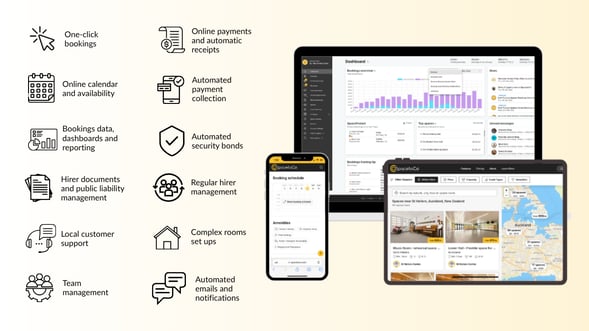
Councils that have brought their facilities onto a shared, marketplace-style platform report measurable gains on both sides of the equation: revenue and admin time.
These outcomes point to the same underlying shift: moving from a system built around a subset of venues to one built around every bookable space in the local government area (LGA), regardless of who runs it day to day.
Does a bookable ecosystem replace our existing council booking software?
Yes, in most cases. If your current software only manages council-run venues, a bookable ecosystem brings community-led facilities onto the same platform too, so you get one system instead of running two side by side. The result: one login, one set of reports, and one place to manage bookings, payments, and admin across every venue in your network.
Will community-led operators need training to use this?
Most platforms built for this purpose are designed for non-technical users, including volunteer committees. SpacetoCo's onboarding is built around getting a venue live with minimal setup time, since community operators typically don't have dedicated IT support.
How does this affect residents who currently book by phone or in person?
Phone and in-person booking doesn't need to disappear. A bookable ecosystem adds an online option alongside existing channels, so residents who prefer to call can still do so, while others can book and pay online at any time without waiting for office hours.
Community facilities carry more of the local wellbeing load than their size or budget suggests, yet bookings for them have lagged behind almost every other council service. Network planning and internal booking tools each address part of the problem, but neither closes the gap between council-run and community-led venues. A council booking system for community facilities that treats every venue as part of one bookable ecosystem, rather than splitting them by who operates them, gives residents a single place to find and book what's available and gives council staff one system instead of several manual ones.
See how a bookable ecosystem model would work across your council's own mix of facilities. Book a demo with SpacetoCo to walk through your current setup and where the gaps are.
.svg)
Book a personalised demo with a local team member




© 2026 SpacetoCo PTY LTD | All Rights Reserved | hello@spacetoco.com | AU: (08) 6102 1191 | UK: 0330 818 2437 | NZ: (09) 887 4698
©️ 2025 SpacetoCo PTY LTD | All Rights Reserved |
AU: (08) 6102 1191 | NZ: (09) 887 4698